
Making a Fermented Drink from scratch with Ginger
- Feb 18, 2024
- 6 min read
So my friends, you might read this and think: what? why? and again what?
I thought the same when I first saw a video pass on my Instagram about making fermented drinks at home using ginger. Yeah, just plain ginger you can buy in the supermarket and fermenting this at home. I was very curious and thought: it seems easy, cheap and looks very delish. So you do not lose much -time, money, effort- in the process of trying! Low risk, potentially high reward = it's go time! Fermented foods are supposedly super healthy and my diet contains none of them, this sparked my curiosity even more and boosted my motivation to try it out.
This post will guide you through the benefits of fermented drinks and how to make the starter culture known as ginger bug yourself and how to use this culture to make a berry soda drink. There are a ton of other recipes out there, this is just one to spark your curiosity!

But what is a Ginger Bug Sharon?!
A ginger bug is a wild, lacto-fermented starter. Okee I got lost in that sentence and you probably too (adapted from wild greens and sardines).
Wild = from naturally occurring bacteria and yeast present in the environment. They are found in the air, the skin of the ginger and the soil.
Lacto-fermented = anaerobic process (meaning without oxygen) by which friendly bacteria, lactobacillus, and yeast break down sugar to form lactic acid and carbon dioxide (CO2), yielding in a bubbly probiotic drink. The CO2 creates the fizz in the finished drink, that is why the drinks are considered soda's!
Starter = meaning creating an environment where beneficial bacteria can thrive and kickstart the fermentation of a new batch of food or drink.
Note
Alcohol is also a byproduct of the lacto-fermentation process, but to make the bug, the fermentation is too short to produce any tangible amounts of alcohol.
You might also think that this is going to be a very sweet drink. Your tiny new friends are going to consume so much of the sugars, not much will be left for you.
Why is this considered healthy?

Ginger bug is considered healthy primarily because it is a natural source of probiotics. Probiotics are beneficial bacteria that live in your gut and play a crucial role in digestion, immune function, and overall health. Drinking ginger bug introduces these good bacteria to your digestive system, helping to maintain a healthy balance of gut flora. This balance is vital for breaking down food, absorbing nutrients, and fighting off harmful bacteria. In essence, ginger bug supports gut health and, by extension, overall well-being.
A recent paper from 2024 by De Oliveira et al. (n.d.) delves deeper into the compounds and microbial and fungal diversity present in ginger bug & ginger beer for those interested to read more on the topic.
Unfortunately, most commercially available fermented foods have been pasteurized, which kills all the good microorganisms and their healthful benefits. So, best to ferment foods at home yourself. Let’s get started with the recipes below!
Ginger Bug Recipe
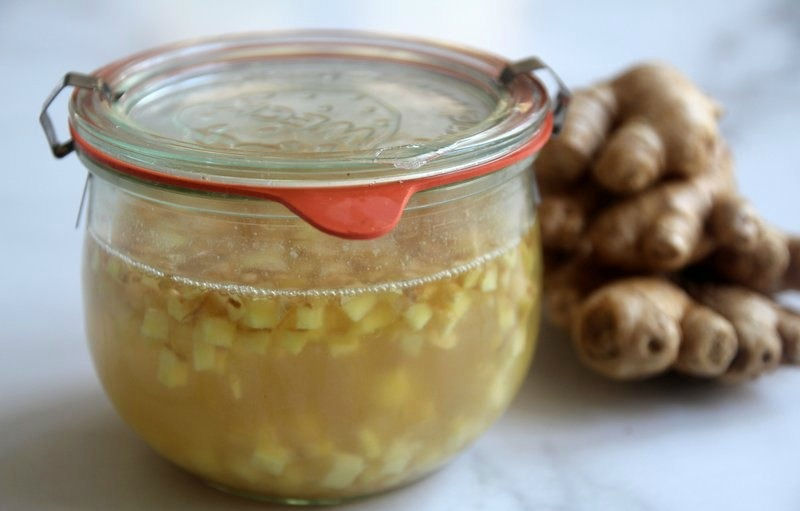
First things first, go to the supermarket and buy a big chunk -or 2- of ginger, you need quite a lot. You also need:
sugar
water
container (just anything you find at home that can be used to store liquids, preferably a bottle)
Blogs online also advice to choose for organic ginger since we wont be cleaning it with soap -the bacteria on the ginger will be part of the starter culture.
So let's start with step one: Making the bug. I followed the recipe from Nourished Kitchen.
Put 2 cups of water in a saucepan on the stove (if you do not own measuring cups -like me-, just use any coffee cup and transfer 2 full cups into a pot).
Add in here 2 teaspoons of sugar and heat up on medium heat until the sugar is completely dissolved. So no need to wait until the water is boiling.
Chop the 30 grams of ginger into very small pieces while the water/sugar mixture is cooling down. I do not own a scale and just eyeballed a good amount of ginger for this step.
Wait until the water/sugar mixture is at room temperature. Go read a book, clean up your kitchen until it feels like room temp.
Once ready, put the ginger in your container and add the water/sugar mixture and close tightly. Leave to culture for one day at room temperature.
This was so far fairly easy and not too time-consuming. This baby now needs to rest for 5 days while continuously needing to be fed -like me. :)
Step 2: Feeding the bug
Your ginger bug should ferment at room temperature and requires daily feeding for five consecutive days. Each day, you should add the following to it:
1 teaspoon of sugar
15 gram of ginger (I eyeballed this again)
Stir well and close your container tightly.
This might seem a bit time consuming but I did this when making tea every morning, really quickly chopping up a random amount of ginger and stirring it in with the sugar. I kept my ginger bug in the living room and kitchen since these are the warmest areas of the house this way the culture grows faster. Keep in mind that if your environment is colder it might take longer.
After 5 days, you should see bubbles appearing in your starting culture and it should smell yeasty, gingery and vinegar-like.
The bug is ready to use! But how can you use this? I used this to make a berry soda but since for this you do not need your entire starter culture, I decided to drink the leftovers with some sparkling water. Yes, you are allowed to just drink the starter culture, it just has very strong flavour.
You can make so many drinks with this ginger bug. The internet is your friend but here are some tips:
Use 1/2 cup of the liquid of the ginger bug and mix with 7 ½ cups of any liquid such as fruit juice, sweetened herbal tea,... Just bottle it up and let it ferment up to 3 days. Important: the liquid should be sugary so the fermentation process can continue.
Note
Mine really wasn't bubbling after 5 days, but I also made it in a sandwich container, so there was a lot of air above the liquid and my apartment is fairly cold. So on day 5 I transferred to a cleaned out yoghurt container with way less free space. I continued for a day longer feeding my bug and stirring this time twice a day.
After 1 day there were a ton of bubbles! So exciting, I made something bubble! So be patient and you will be rewarded! 💖
Fermented Berry Soda
To make a lovely fruit based soda you need:
7 cups water
2 tablespoons sugar
6 cups fresh/frozen berries
1 cup ginger bug (just the liquid part)
I opted for frozen berries so defrosted them first for a while until they reached room temperature.
Heat up the water, sugar and berries in saucepan on medium heat until the sugar is fully dissolved. Let cool until it reaches room temperature.
Strain the soda base from the berry pieces.
Poor the berry juice in any bottle you have and mix the ginger bug. There should only be a bit of air space left at the top. Let this ferment 2 to 3 days.
After transfer to the fridge before consuming and be careful when opening.
I was able to taste mine on Valentine's Day and it was so good! It taste a bit like a kombucha drink but way cheaper and the excitement of seeing the growth of the bug on the daily was so fun! Definitely will be trying in the future other drinks with this ginger bug recipe.
I hope you feel motived to try to make this drink or the ginger bug. It is easy, cheap, fun and super healthy! Making something like this made me feel like a sorceress and I loved it.(๑'ᵕ'๑)⸝*✨ If you give this a try please share what you did and if you liked it!
Bubbly kisses
Sharon
References
Wild Green and Sardines: Ginger Bug: A Wild, Lacto-Fermented, Probiotic Beverage
De Oliveira, L. I. G., Da Costa, W. K. A., De Candido De Oliveira, F., Bezerril, F. F., Eireli, L. P. a. M., Lima, M. D. S., Noronha, M. F., Cabral, L., Wagner, R., Pimentel, T. C., & Magnani, M. (n.d.). Ginger beer derived from back-slopping: Volatile compounds, microbial communities on activation and fermentation, metabolites and sensory characteristics. Food Chemistry, 435, 137640. https://doi.org/10.1016/j.foodchem.2023.137640
Ziet er echt lekker uit!! :))